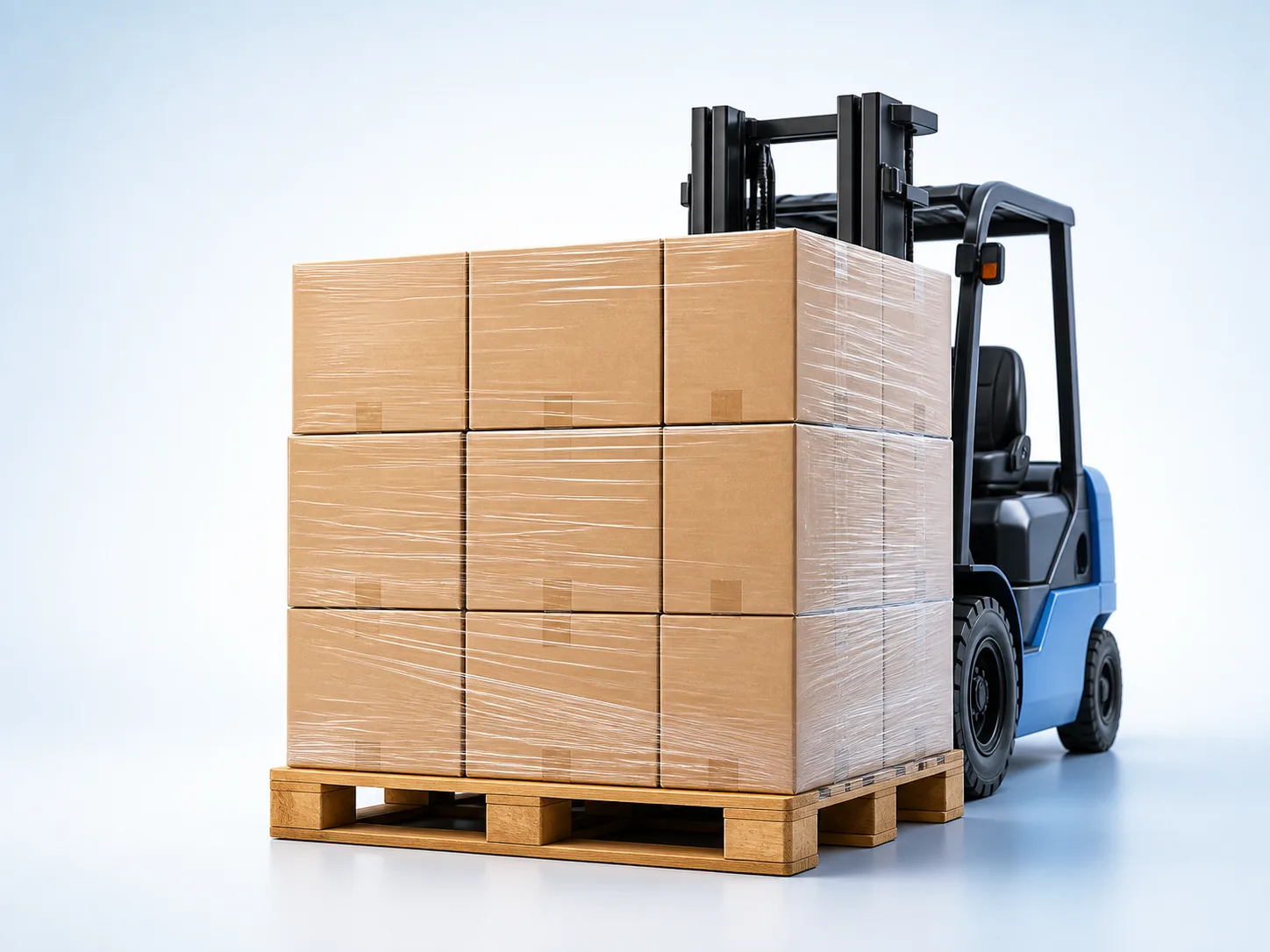
Trailer capacity

How many pallets fit in a 53-foot trailer?

Twenty-six on the floor loaded straight, thirty if every pallet is turned, and roughly double either number when the freight stacks. The count matters less than the linear feet it eats, because that figure is what decides whether a carrier still prices your load as LTL. Trailer specifications and two carrier tariffs are cited below, all read 2026-07-28.

Builder specs citedTariff items quotedRead 2026-07-28
Pallets loaded into a 53-foot dry van trailer
Floor space is the currency

Carriers rate a trailer by the feet of deck you occupy, not by how many skids you counted onto it.

The trailer, as its builder publishes it

Every pallet count is arithmetic performed on four numbers, so here are those numbers from a manufacturer rather than from folklore. The figures below come from Utility Trailer's published dry van specification page at utilitytrailer.mediafuel.net/dry-vans/specifications, read 2026-07-28. Two inside widths appear because the composite models differ slightly at the wearband.

Published composite dry van specifications from utilitytrailer.mediafuel.net, read 2026-07-28. No prices are shown because trailer builders do not publish freight rates.
SpecificationAs publishedWhat it decides
Overall length53 ft 0 inHow many rows of pallets the deck can hold end to end
Inside width at wearband100 in or 101 inWhether pallets sit two abreast on their long face or their short one
Inside height110 1/2 in front, 111 in rearWhether a second tier of freight goes on top
Overall width102 3/8 inThe outside envelope the highway allows
Payload capacity55,000 lbAverage weight per pallet before the trailer runs out of rating
Gross vehicle weight rating65,000 lbTrailer plus cargo, before the tractor is counted

The 53 ft figure is the outside of the box. Front wall, rear frame and door hardware take some of it, so the deck a forklift can reach is a little shorter, and each floor plan below is built to survive that difference rather than depend on an exact inside length.

Two floor plans, and the arithmetic behind them

A grocery pallet is 48 in by 40 in, the footprint Estes publishes as the standard deck. Which of its two sides faces the sidewall is the whole question, and it changes the answer by four positions.

Straight loaded: 26

Each pallet turns its 40 in edge toward the wall, so a pair uses 80 of the 100 in available and every row eats 48 in of deck. Fourteen rows would demand 672 in of floor against a trailer 636 in long overall, so thirteen rows is the ceiling and 26 is the count.

Turned: 30

Point the 48 in face across instead and a pair spans 96 in, leaving four or five inches of daylight. Each row now costs only 40 in, fifteen rows fit inside 600 in, and the trailer holds 30 positions with a stub of floor left at the doors.

Stacked: double either

With 110 1/2 in of headroom, two tiers of freight built to 48 in plus their decks clear the roof comfortably. Loads that carry weight on top reach 52 or 60 positions, which is why stackability is asked before anything else.

Shippers call the turned pattern pinwheeling, and the four inches of slack is exactly where it fails. Stretch wrap bulging past the deck edge, a carton hanging over by an inch, a broken block on one corner: any of those turns a 30-position plan back into a 26-position one at the dock, after the truck has already been rated. Measure a wrapped pallet, not a bare one.

Weight arrives at its own ceiling. Spread the published 55,000 lb payload across 30 positions and the average pallet may weigh about 1,833 lb; across 26 it may weigh about 2,115 lb. Dense freight hits that wall long before the doors close, which is why beverage and tile loads leave visible empty deck behind them.

When does a pallet count stop being LTL?

Carriers do not switch modes because you reached a round number of skids. They switch when your freight occupies enough deck that nobody else's freight can ride with it, and each carrier writes that threshold into its rules tariff. Two national tariffs, read 2026-07-28, draw the line in different places.

Thresholds quoted from the FedEx Freight 100 series rules tariff on fedex.com and tariff ODFL 100-Q on odfl.com, both read 2026-07-28. Tariff dollar minimums are deliberately not reproduced here.
RuleFedEx FreightOld Dominion
Capacity load by floor space15 linear feet or more20 linear feet or more
Extra condition on that triggerFreight 5 ft wide or wider, or nothing identical can be added beside itApplies regardless of weight
Capacity load by weightMore than 15,000 lb20,000 lb or more
Where LTL is defined to endUnder 20,000 lb and less than one pupUnder 20,000 lb or under 20 linear feet
A pup, as definedOne trailer up to 29 lineal feet of loading spaceNamed alongside trailer in the same definition
Deemed weight by floor space1,000 lb per lineal foot from 10 lineal feet upNot stated in the item read

Translate the left column into skids and the picture sharpens. Straight-loaded rows of two cost four linear feet each, so four pallets take eight feet, six take twelve, eight take sixteen and ten take twenty. That puts an eight-pallet shipment past the FedEx Freight trigger and a ten-pallet shipment past Old Dominion's, and a load that cannot go two abreast burns the same footage for half the pieces.

The deemed-weight rule catches more shippers than the capacity rule does. Item 616-2B sets a minimum of 1,000 lb per lineal foot once a shipment occupies ten lineal feet or more, so six pallets of pillows are rated at 12,000 lb whatever the scale reads. The same item cubes any handling unit 60 in tall or marked non-stackable to 96 in of height, which means writing non-stackable on the bill of lading has a price even when nothing was ever going to be stacked on it.

Have a manager price the load Work out the class first

Using the count before you book

  1. Measure a finished pallet. Wrap, corner boards, and any carton that hangs over the deck all belong in the number you give the carrier, because they are what the dock will see.
  2. Convert skids into feet. Two abreast, four feet per row; single file, four feet per pallet. That figure is what the tariff reads, and it is the one worth putting on your rate request.
  3. Decide stackability honestly. A tier of freight on top halves your floor space, and a non-stackable note buys height you will pay for either way.
  4. Watch the weight ceiling as well as the floor. Dense freight runs out of payload rating with deck to spare, and light freight runs out of deck with tons to spare.
  5. Ask for both quotes past six pallets. Around twelve to twenty linear feet the shared-trailer price and the whole-trailer price start crossing, and the only way to know which side you are on is to price both.

Common questions

How many pallets fit in a 53-foot trailer?

Twenty-six standard 48 by 40 in pallets loaded straight, or thirty when every pallet is turned so its 48 in face runs across the trailer. Freight that takes weight on top doubles either figure, up to the published inside height.

What does pinwheeling a trailer mean?

Rotating pallets so their long face runs across the trailer rather than along it, which buys back the strip of width a straight load wastes. It only works if nothing overhangs the deck, because two 48 in faces already use 96 of the 100 in inside the walls.

How many linear feet does a pallet take up?

A straight-loaded row of two 48 by 40 in pallets uses four linear feet of deck, so six pallets take twelve and ten pallets take twenty. Freight that cannot be loaded two abreast uses the same footage for half the count.

At how many pallets does LTL stop working?

It depends on whose tariff prices you. FedEx Freight can call a shipment a capacity load from 15 linear feet, which is eight straight-loaded pallets, while Old Dominion draws its line at 20 linear feet or ten pallets. Both figures were read on 2026-07-28.

Can a light load still be billed as a heavy one?

Yes. Under FedEx Freight item 616-2B, anything occupying ten lineal feet or more carries a minimum weight of 1,000 pounds per lineal foot, so a bulky twelve-foot load rates at 12,000 pounds no matter what the scale says.